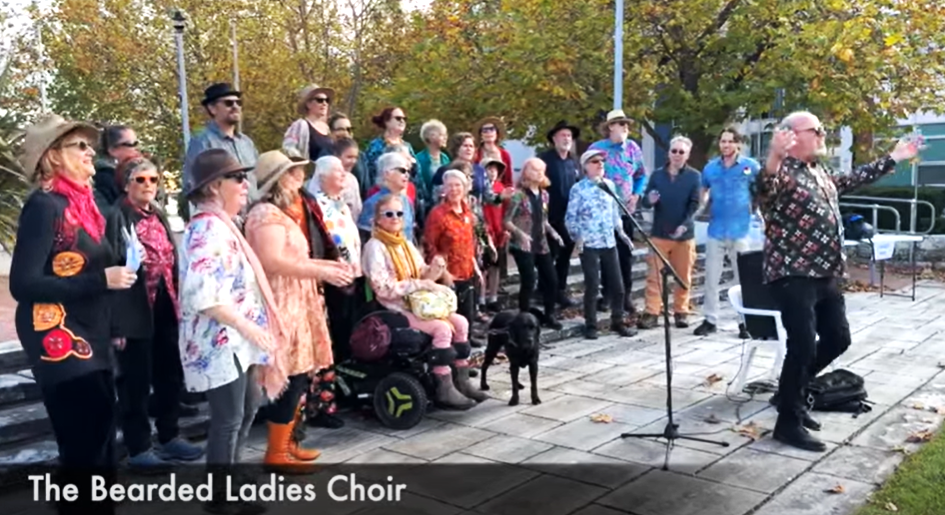
Over 120 people attended the Anzac Day Reflection held during the afternoon of Friday 25th April 2025 in Katoomba’s Peace Park. This was the first time that such an event has been held in the Blue Mountains.
Organised by the Blue Mountains Peace Collective (BMPC) and facilitated by Jon Atkins, the program included:
- Peace Sculpture
- Why an Anzac Day Reflection?
- Acknowledgement of Country
- Song by local choir
- Poetry and reading
- One minute’s silence
- Speaker on impacts of the Great War
- More poetry
- Extra songs by local choir
- Speaker on building peace
- Raffle and announcements.
Among those who attended were local councillors and representatives from Radio Blue Mountains, Mountains for Palestine and the Greens.
Peace Sculpture
At the start of the event, reference was made to Tom Coley and his imposing Peace Sculpture which is located in the corner of the Peace Park.
Tom donated the sculpture to the Blue Mountains Council in 2009.
He died in December 2018 with no plaque having been attached to the plinth.
As a result of Clr Sarah Redshaw’s notice of motion in November 2023 which was supported by all councillors at the time, council installed a plaque. However, the plaque does not acknowledge Tom as the sculptor since, at the time of donating the sculpture to council, he specifically requested that his name be omitted from the plaque.
Why an Anzac Day Reflection?
While we come together on this day to remember Australian casualties during WW1, including the ill-fated Gallipoli campaign, as well as in other wars and conflicts, Anzac Day Reflections have a number of distinctive features.
Jon Atkins summarised these as follows:
- The tributes paid to the victims of WW1 (and other wars) are inclusive. They include Aboriginal servicemen who lost their lives, those who returned maimed and brutalised by war, grieving loved ones and relatives on the homefront, as well those who were vilified and persecuted for opposing war and supporting peace.
- Hard questions being asked about the Gallipoli campaign and other military engagements e.g. (a ) Why did we so readily go to war? (b) What was achieved? and (c) Was engagement in our long term national interest? It was argued that we need to learn from past military tragedies so we can minimise them occurring in the future.
- Rejecting all the “add-ons” that now seem inseparable from Anzac Day commemorations. These include such fictions promoted by the Anzac legend as (a) the nation was born as Gallipoli (b) it was our first blood sacrifice (c) our national identity was established in war time (d) we fought at Gallipoli for freedom and democracy and (e) our national values are military values.
In conclusion, it was stated that “the promotion of the Anzac legend, by distorting our history and discouraging critical inquiry, has helped to suppress public resistance to Australia’s engagement in foreign wars in the service of “great and powerful friends” – in the past, this was British Empire – today, it’s the most belligerent of nations, the USA.”
Acknowledgement of Country
Uncle Chris Tobin, a Dharug elder, provided an Acknowledgement of Country. He said he had increasingly questioned official Anzac Day commemorations. In particular, he noted that the Anzacs were still British subjects, not Australian citizens at the time of the Great War. Rather than fighting for freedom and democracy as claimed by the Anzac legend, what the Anzacs went to die for was King and Empire.
Chris went on to say that Anzac Day commemorations “should be a useful thing for us, so we don’t get carried away.” He noted that “when we acknowledge country in Australia we are dismantling that nationalism that is so destructive around the world.” He added that what we need to do is “to recognise the sacrifice of those brave young souls” who perished at Gallipoli and on the Western Front, but to “do it respectfully … with sadness, not with pride.”
Choir – Act 1
After the Acknowledgement of Country, the Bearded Ladies Community Choir from Katoomba, comprising 25 singers and led by Michael Macken, sang ‘The whole world is dreaming’ by Mark Seymour.
Poetry and reading
The choir’s first act was followed by some poetry and a reading.
Local poet, Brian Bell, recited one of his own poems called ‘Garden of Peace’.
This was followed by Mark Hillis from BMPC who read an extract from an article entitled ‘Anzac Day’ by the historian Henry Reynolds.
In that extract, Henry Reynolds notes that official Anzac Day commemorations pay tribute to the sacrifice of our war dead, but the suffering and the death of first nations people in the frontier wars, involving the long drawn out conquest of indigenous Australia, is ignored.
He also notes that our national lament is for those who perished overseas in wars chosen for us by our great and powerful friends, against enemies who lacked the capacity to threaten Australia.
Reynolds then asks: “How is that commensurate with frontier wars fought in Australia about the ownership and control of the continent itself?
In response, Reynolds emphasises that as far as Australia is concerned, the frontier wars were of “far greater significance than the balance of power in Europe or the scramble to carve up the remains of the Ottoman Empire.”
One minute’s silence
After the poetry and reading, a period of one minute’s silence and reflection was observed.
Impacts of the Great War
Next, social historian Dr Naomi Parry Duncan spoke about the impacts of World War I on Australia’s economy and society.
Prior to the outbreak of the war, Australia was described as a “miracle economy” with world leading education, health and welfare systems at the time.
However, social conditions began to change when Australia got swept up during the enormous mobilisation of military forces prior to the outbreak of the Great War. Subsequently, Australia began to introduce measures such as compulsory military training – vehemently opposed by many – as well as the War Precautions Act 1914 under which many people who opposed war and spoke up for peace were harshly prosecuted.
In an impassioned conclusion, Naomi said:
“What I want to say is down with nationalism, up with collectivism, up with our hearts, our minds and our bodies. There is no just war but series of just fights.
What we need to fight for is our right to organise, to be together, to achieve the peace and the harmony that take us back to something like the paradise that we were before war smashed our economy, killed 62,000 of our people, left 150,000 maimed and a quarter of a million people dependent on government pensions and sucked the life out of our economy.”
Extra poetry
After Naomi’s speech, local resident, June, recited one of her poems called ‘Lament for Madame Curie’.
The next poem called ‘Weapon’ by Judith Wright was recited by Rowe Morrow from BMPC. Prior to reciting the poem, Rowe referred to the terrible consequences of war, including those she observed when visiting war-torn Vietnam and Cambodia in the mid 1980s.
Choir – Act 2
The Bearded Ladies Choir returned to sing two more songs: ‘Shower the People’ by James Taylor and a rousing rendition of ‘Give Peace A Chance’ by John Lennon and Yoko Ono that enticed the whole gathering to join in and clap in unison.
Building peace
Following the choir’s last songs, Jon Atkins addressed the topic of building peace.
With respect to initiatives that could be taken today to advance the cause of peace, the following actions were nominated:
- Back calls for the official recognition of the Frontier Wars by the Australian War Memorial and the impact they had on Indigenous dispossession.
- Support the campaign by Australians for War Powers Reform (AWPR) for the democratisation of war powers by the Commonwealth Parliament.
- Support the InternationaI Campaign to Abolish Nuclear Weapons (ICAN) and its campaign for the Albanese government to sign and ratify the UN Treaty on the Prohibition of Nuclear Weapons (also known as Nuclear Weapon Ban Treaty) without further delay.
- Support the Independent Peaceful Australia Network (IPAN) and its campaign for the Federal government to develop independent foreign and defence policies.
In conclusion, people were urged to support genuine remembrance, not ‘Anzackery’ or celebrations of mythology with political overtones.
In supporting genuine remembrance, the following question was posed:
How can we protect Anzac Day as an occasion devoted to reflection and mourning and prevent it from becoming a political tool or a justification for future bloodbaths?
With election day on the 3rd May looming, it was suggested that:
“The one thing we can do is to elect parliamentary representatives who are committed to independent foreign and defence policies and who demand of the Australian government that it becomes a champion of peace, diplomacy and reconciliation in regional and global forums, including the United Nations.
Being recognised as a champion of peace will help to diminish the country’s obsession with military commemoration and discredit the view that our engagement in foreign wars has been a defining collective experience.”
Raffle
Clr Suzanne Jamieson, who was representing Susan Templeman MP at the gathering, was asked to come forward and draw the winning tickets.
The two raffle prizes given out at the event were:
- 1st prize – $50 voucher donated by Gleebooks, Blackheath
- 2nd prize – Douglas Newton’s Private Ryan and the Lost Peace: A Defiant Soldier and the Struggle Against the Great War.
After a number of announcements, many participants came forward and expressed their support for another Anzac Day Reflection being held in Katoomba next year.
♦ ♦ ♦ ♦ ♦ ♦
Notes
Dr Naomi Parry Duncan – Video of Impacts of the Great War.
Uncle Chris Tobin – Recording of Acknowledgement of Country.
Jon Atkins – Text of ‘What makes Anzac Day Reflections distinctive?‘ and video of ‘Building peace‘.
Tom Coley – Brief biography and photo of his sculpture entitled ‘Peace Memorial’. Also an informative article by Carolynne Skinner on Tom Coley’s life and work can be found here.
Refer as well to the Blue Mountains Peace Collective’s Facebook page and website.